
"I Wore Foot-Shaped Shoes Every Day for 11 Months. Here Are 10 Reasons Why I’ll Never Go Back."


THE 10 REASONS WHY

1. Your toes are supposed to spread.
A baby's foot is shaped like a fan, widest across the toes. That isn't random; it's what gives you balance, a stable base, and push off power. Then we put shoes on the baby, and over the next six decades the fan slowly closes. By the time you're forty, your foot has been quietly reshaped to match the inside of your shoes, not the other way around. Barefoot shoes are built around the original shape of the foot. Conventional shoes are built around the shape of a riding boot from the 19th century.

2. Most "foot problems" are shoe problems.
Bunions. Hammertoes. Plantar fasciitis. Morton's neuroma. These conditions are remarkably rare in populations that don't wear conventional shoes, and show up reliably in populations that do. The single biggest variable that predicts them isn't genetics or age. It's what people have been wearing on their feet.

3. Cushioning makes your feet weaker, not stronger.
This one took me the longest to accept. A pillowy sole feels good, and the marketing all says "support." But cushioning works the same way a sling does: it offloads work from a muscle, and the muscle gets weaker. Your foot contains 26 bones, 33 joints, and over 100 ligaments, muscles, and tendons. A thick foam sole doesn't strengthen any of it. It just lets it sleep.

4. A raised heel changes how your entire body stands.
Even "flat" sneakers usually have 8 to 12 millimeters of drop from heel to toe. That tilt cascades up the whole kinetic chain: the pelvis tips forward, the lower back curves more deeply, the head juts forward. None of it is dramatic on any given day, but it adds up over decades. Barefoot shoes are zero drop; the sole is the same thickness at the heel and the toe. The first time you wear them, you can feel that you're standing differently. Because you are.

5. A wide toe box doesn't just feel better. It protects you!
Bunions don't form purely because of genetics. They form because the big toe gets pushed sideways, by the shoe, for decades. The same is true of most toe deformities people fear as they age. Give the toes room and they slowly migrate back toward their natural position. The two photos at the top of this page are what eleven months of room looks like.

6. Your feet have over 200,000 nerve endings. Thick soles silence them.
Your feet are among the most sensitive parts of your body, denser in nerve endings than your hands. Those nerves are constantly telling your brain about the ground: where the pressure is, where the surface tilts, what's stable and what isn't. A thick foam sole is, effectively, a mitten on that sensory system. Thin, flexible soles let the information come through, and balance tends to improve quickly once it does.

7. Strong feet mean stronger knees, hips, and back.
The foot is the foundation. When the foundation is weak, tilted, or numb, every joint above it is compensating. People with chronic knee, hip, or lower back pain are often, without knowing it, compensating for feet that have been quietly disabled by decades of cushioned, structured shoes. You can't reliably fix the roof when the foundation is off.

8. The single best thing you can do for mobility in your 60s, 70s, and 80s.
Falls are the leading cause of fatal injury in adults over 65. Falls happen when balance fails. Balance starts at the feet. Stronger feet, better proprioception, and a wider, more stable base of support are some of the most underprescribed interventions for staying mobile and independent as you age. The earlier you start training your feet, the more you have to draw on later.

9. They don't look weird anymore.
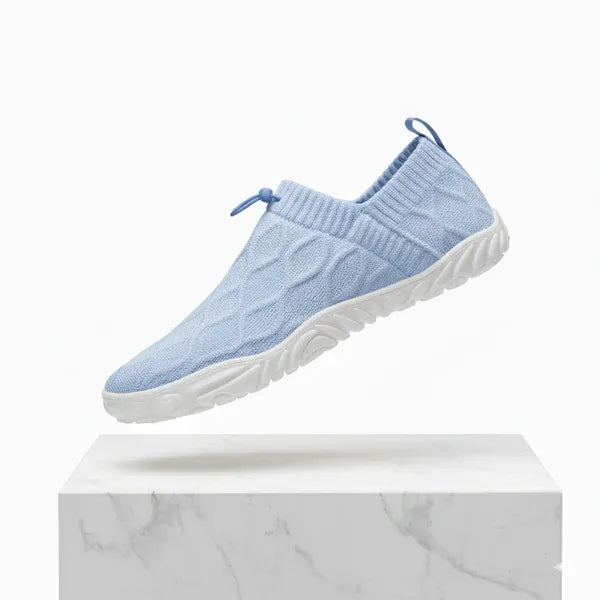
The first generation of barefoot shoes looked like rubber gorilla feet. Fair enough; that's why most people noped out and never came back. The current generation does not. Barefoot Flow looks like a normal sneaker from the outside. Clean lines, neutral colors, nothing that announces itself. The shape of the foot is on the inside, where it belongs. You can wear them to work, to dinner, on a long walk. Nobody is going to know but your toes.

10. The transition is gentler than you think, and the risk is zero.
You don't need to throw out every other shoe you own. Start by wearing barefoot shoes for an hour or two a day, and build up over a few weeks. Your feet will get a little sore the way a muscle gets sore at the gym, because that is, in fact, what is happening. And because we offer a no questions asked return policy, the only thing you risk by trying a pair is finding out you actually like them. Eleven months from now, your toes might look different too.